Why Chimneys Leak in Northwest Arkansas
Most chimney leaks come from one of five places, and knowing which one is half the repair.
September 30, 2026 · 3 min read
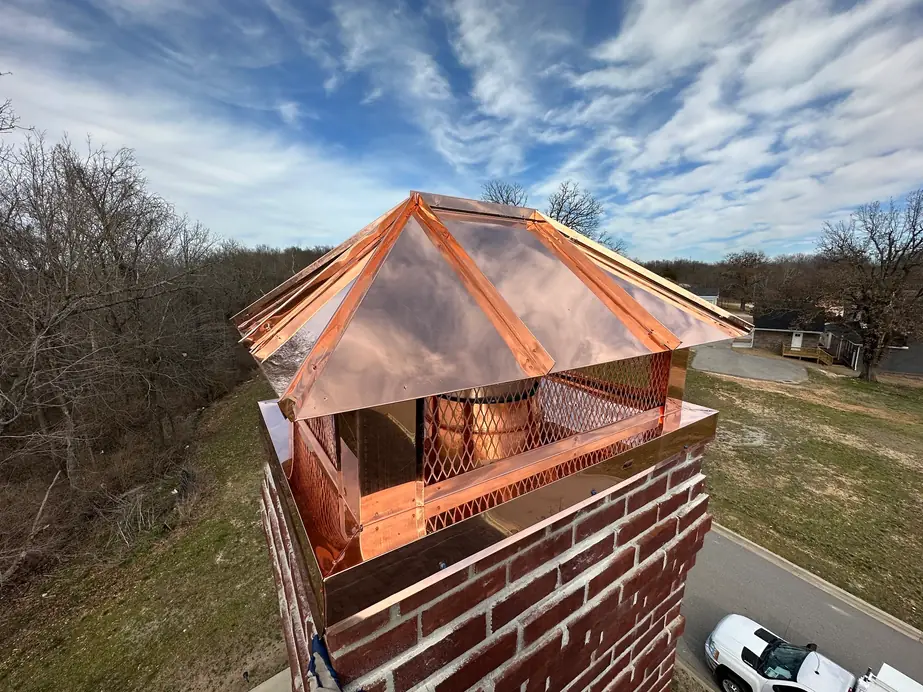
A leaking chimney can cause serious structural damage, interior staining, mold growth and costly masonry deterioration. The frustrating part is that the water you see inside the house is rarely at the spot where it got in. It runs along a framing member, down a flue wall or across the back of a ceiling before it shows up as a stain. Finding the real entry point takes knowing where chimneys fail. In our part of Arkansas, with heavy rain, wind-driven storms and a steady cycle of freezing and thawing, the same handful of weak spots come up again and again.
The crown, the cap and the chase cover
The crown is the concrete top of a masonry chimney that seals and protects everything below it. Cracks, spalling or poor construction let water soak into the brick and mortar. Small hairline cracks matter because water gets into them, freezes, expands and makes them bigger. Over a few winters a hairline turns into a gap.
Prefabricated chimneys, the metal-framed kind often boxed in with siding, use a metal chase cover to keep water out of the top of the system. Rusted, warped or poorly fitted chase covers are a common cause of leaks, and they're easy to overlook because they sit up where nobody looks. A damaged chase cover can be replaced, or fabricated to fit if the chimney isn't a standard size.
A chimney cap keeps rain, debris and animals out of the flue. When the cap is missing or damaged, rain goes straight down the flue, and you can end up with moisture damage, blockages and drafting problems all at once.
Flashing at the roof line
Flashing seals the joint where the chimney meets the roof, and it's one of the most common causes of chimney and roof leaks. It's built in layers: step flashing woven into the shingles along the sides, and counter flashing tucked into the masonry above it. When the sealant dries and cracks, when the metal corrodes, or when it was installed poorly to begin with, water finds the gap. The leak looks like a chimney problem, but the chimney itself may be perfectly sound.
That's where being both a chimney company and a roofing company helps. Because Top Hat works on both systems, we can work out whether the water is coming from the chimney structure, the flashing or the surrounding roof, instead of sending you from one contractor to another, each pointing at the other trade.
Porous masonry and freeze and thaw
Brick and mortar are porous. They absorb water slowly over time, and a chimney stands higher and more exposed than any other part of your house, with weather hitting it from every side. When absorbed water freezes, it expands inside the brick and mortar joints. Repeat that enough winters and you get cracking, flaking brick faces and mortar that crumbles when you rub it. Waterproofing with a breathable sealant helps protect the masonry from moisture while still letting it dry out, and it's a smart preventive step on a chimney that's otherwise sound.
Signs you might have a leak
Not every leak drips. Many show up quietly first, and the earlier you notice, the cheaper and smaller the fix tends to be. Watch for these:
- Water stains on the ceiling or walls near the chimney, or around the fireplace opening
- A musty odor in the room, especially after rain
- Crumbling mortar, flaking brick or white powdery staining on the outside of the chimney
- Rust on the damper, firebox or chase cover
- Daylight or standing water where there shouldn't be any
If you spot any of these, don't wait for the next big storm to confirm it. Water that's been getting in for a season has usually already done damage you can't see.
Fixing it for good
A real fix starts with finding the actual source, then addressing it: crown crack sealing, resurfacing or a full rebuild, a replacement chase cover, a properly sized cap, new step and counter flashing, and waterproofing where the masonry needs it. Patching the stain while the source stays open just buys you a few weeks. Waterproofing services from Top Hat are covered under our 10 Year Edge-to-Edge Leak-Proof Warranty on qualifying work.
If you're in Springdale, Fayetteville, Rogers, Bentonville or the River Valley and you've noticed a stain, a smell or crumbling mortar, call Top Hat Chimney & Roofing at (479) 751-0432 and we'll track down where the water is getting in.
Top Hat Chimney & Roofing, (479) 751-0432
Call (479) 751-0432More articles
Keep Your Home Happy and Gutters Clean
A clogged gutter does its damage quietly, and by the time you see it the water has already gone where it shouldn't.
Professional Roofing & Gutter Repairs
Repair or replace: the answer depends on the damage, how much of the roof it touches, and how old the roof is.