Chimney
Chimney sweeping that leaves your living room clean
Certified sweeps for wood stoves, inserts and masonry fireplaces across Springdale and Northwest Arkansas, with the soot staying in the flue where it belongs.
Chapter 01
What actually builds up inside a flue
Every fire leaves something behind. Smoke carries unburned gases up the flue, and when they hit the cooler liner walls they condense into creosote. In the first stage it is a dry, flaky soot you can brush off. Left alone it turns tarry and sticky, and then it hardens into a shiny black glaze that looks like varnish. Glazed creosote is the hard one, because an ordinary brush just skates over it.
Creosote is highly combustible, which is why a dirty flue is a fire hazard and not only a housekeeping problem. Nests and debris add a second risk. A bird's nest or a plug of leaves can choke the draft completely, and smoke has nowhere to go but back into the room.
The tells are easy to miss until they get bad: smoke backing into the house, a fire that is slow to catch, a sharp tar smell when the weather turns damp. If you notice any of them, call the Springdale shop at (479) 751-0432 before you light another fire.
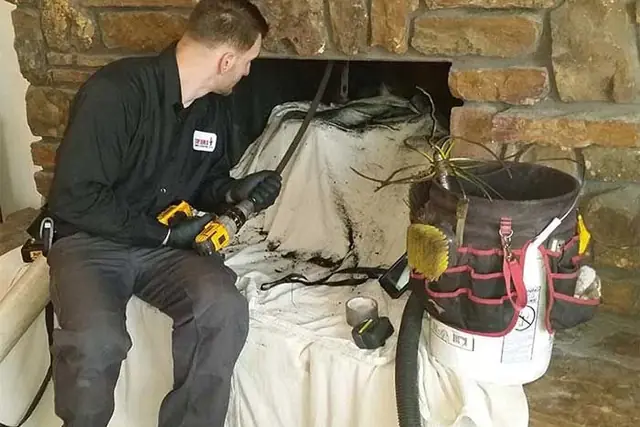
A Top Hat chimney sweep working over a drop cloth
How a Top Hat sweep runs, start to finish
Before a brush touches the flue, the crew lays protective coverings from the entry point to the fireplace and wears foot protection, so soot does not get tracked through your house. Then specialized brushes and professional grade equipment go to work on the liner, the smoke chamber and the firebox, with mechanical and power sweeping where the buildup calls for it.
A RoVac HEPA filtered vacuum runs the whole time to capture airborne dust and debris. Bird and animal nests come out, blockages come out, and glazed creosote gets its own treatment, since a plain brush will not break it up. Our technicians are CSIA certified, and Top Hat has been sweeping chimneys in Northwest Arkansas since 1983.
One long-time customer, Bob Scharf, summed it up in a Google review: on time, "thorough, clean, knowledgeable." That is the standard we hold the crew to on every job.
Chapter 03
After the sweep: how often, and what we flag
How often you need a sweep depends on how much you burn and what you burn. A household running a wood-burning stove all winter builds deposits far faster than a gas fireplace lit a few times a year. An annual inspection is still the most reliable way to know when your chimney actually needs sweeping, so you are not guessing by the calendar.
A sweep also puts a technician face to face with the liner, the smoke chamber and the firebox. If we find cracked masonry, a failing liner or signs of water getting in, you will hear it from us before it turns into a costly repair. Hayley, in her third year of chimney care with Top Hat, wrote that Elijah "has always gone out of his way to educate us and to help us care for our wood-burning stove and chimney."
CSIA certified chimney techs from Springdale since 1983. Call (479) 751-0432.
A sweep shows you what the flue looks like today. For the full picture of the liner and the masonry, book a chimney inspection. If the brush turns up crumbling joints or a cracked liner, our chimney repairs team can scope the work from what the inspection found. Thinking about replacing an old firebox with a stove or insert? Start with fireplace installation.